Thursday, 21 July 2011

UK Optimisation

Business a green way

Get your project delivered within a specific time frame. Ensure good search engine optimization is employed. Get service from expert and experienced web and graphics designers. Reduce your project costs. We deliver quality all the time. Customized web designs and … Continue reading

Green Solutions for Business

It is really important to appear to be green. Having an environmentally-friendly site is a great accomplishment and a great selling point. Let your site visitors know your site has gone green by letting us build you a low carbon … Continue reading

Video – promote business?

What is the best way to promote your business? There is a lot written about the advantages of using promotional videos to sell goods and services but… Who is better to use, flickr.com or YouTube.com? I don’t actually know the … Continue reading

Business Solutions are not a liquid.

Creating a showcase for your products is important and being able to provide your products or services on line is perhaps the easiest way of doing this. However, the process of managing and building a commercial web site is extremely … Continue reading

Green business store

Having your own business online store to run can sometimes prove to be a false economy of time and resources. Maintaining and running the venture could be a waste of time without using other methods of attracting new clients. We … Continue reading

Wednesday, 22 June 2011

Are these Keywords the best?

First in Google?: Are these Keywords the best?: "Are these Keywords? : 'The example below is how not to use words in Search Engine Optimisation. The text is crammed with loads of words but ..."

Sunday, 19 June 2011

First in Google - Beauty and the Beast - Photographs

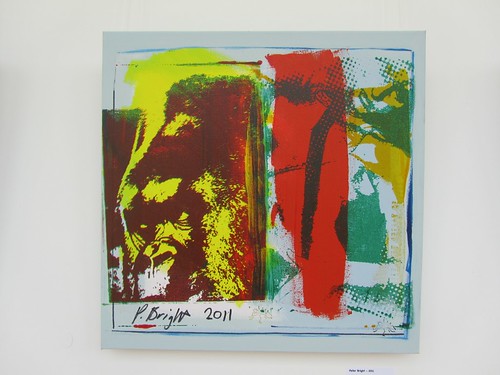
First in Google?: Beauty and the Beast - Photographs: "Beauty and the Beast - painting 2011 : ' What is the relationship between the woman and the ape? Who is the beast? ...' Images of Printmaking..."

Friday, 17 June 2011

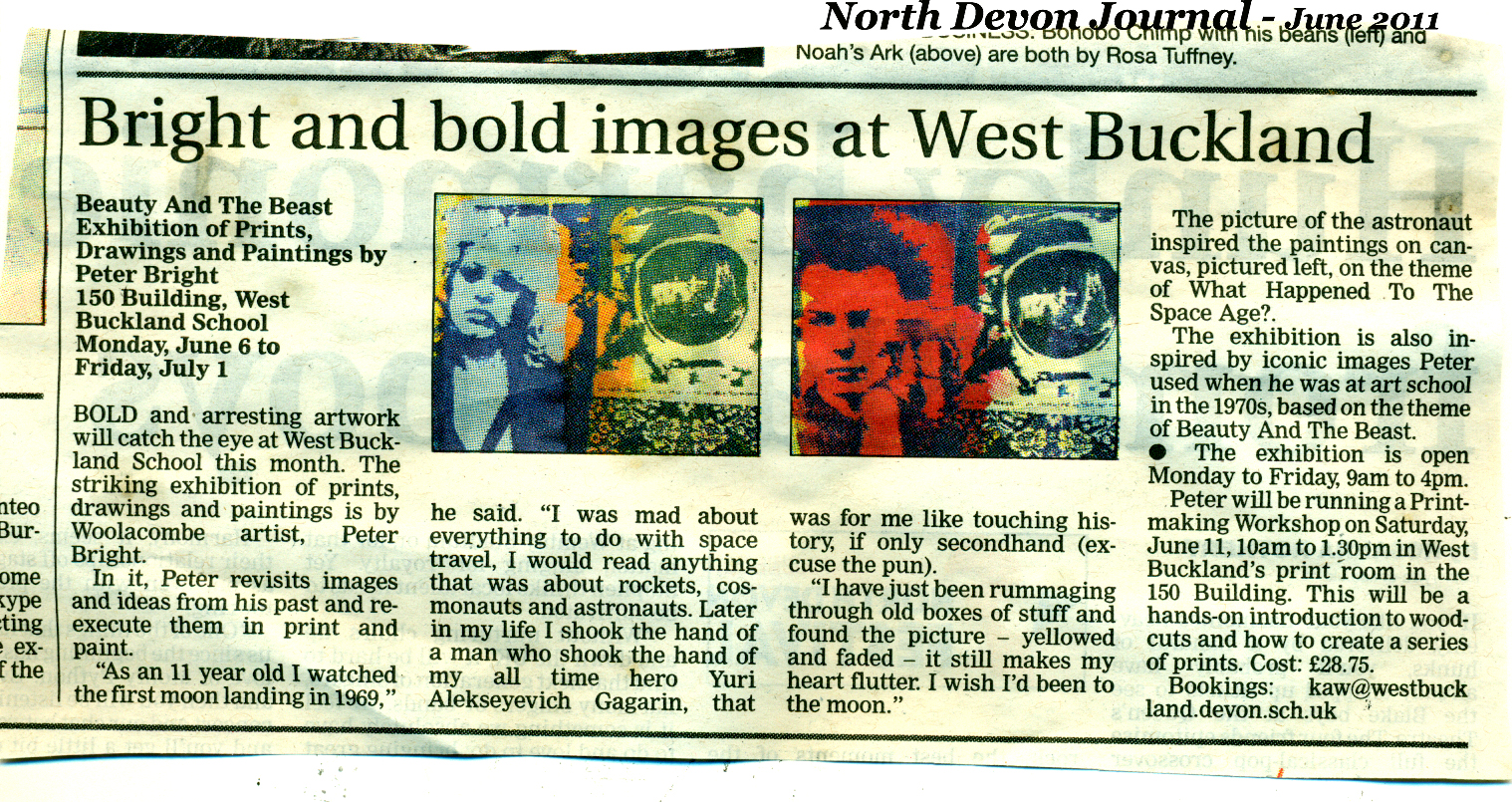
Exhibition Press Clipping

Exhibition Press Clipping: "Here is a newspaper clipping about the exhibition of Peter Bright at West Buckland school."


Beauty and the Beast

Tuesday, 14 June 2011

Sitemaps and Seo - First in Google?: Green solar power feed in tariff

Sitemaps and Seo - First in Google?: Green solar power feed in tariff: "Government confirms outcome of fast track review on Feed-in Tariff (FIT) levels of support for large scale solar New tariffs for large scale..."

This Window - 'Cassette Culture': Nude Woodcut

This Window - 'Cassette Culture': Nude Woodcut: "Nude Woodcut , a photo by This Window on Flickr. This series of woodcuts is available to purchase. This image was exhibited in the 150 Bui..."

Sitemaps and Seo - First in Google?: Green solar power feed in tariff

Sitemaps and Seo - First in Google?: Green solar power feed in tariff: "Government confirms outcome of fast track review on Feed-in Tariff (FIT) levels of support for large scale solar New tariffs for large scale..."

Thursday, 26 May 2011

Art?

Rediscovering the printing process after nearly 40 years has been an interesting process - disappointingly modern inks are not as rich in colour (earthy colours are very plastic like) and modern waterbased inks don't become part of the surface, they sit on it, which is incredibly frustrating - the reason I took up printing in the first place was because of the absorbed flatness of the pigments.

The image below is a lithograph I did in 1978.


Printmaking 2011

My heroes have grown old with me or they have died - maybe their death has been a way to freeze time, stop the aging process - not only for them but for me also?

'Peter's exhibition was inspired by iconic images he used when he was at art school in the 70s on the theme of Beauty and the Beast - inc Sid and Nancy and Guy the Gorilla! - and I think the results are really bold and impactful.'
 

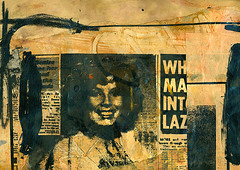
I have always been a hoarder, newspaper clippings, postcards etc. It is only now that I have decided to recycle them.


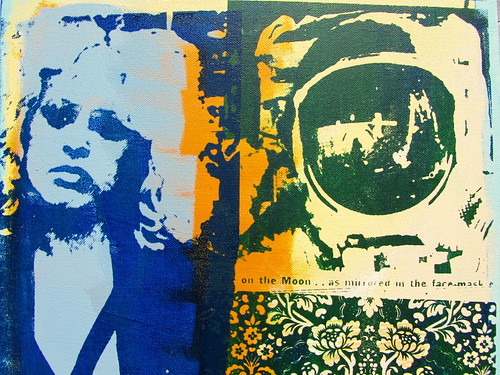
What is the relationship between the woman and the ape? Who is the beast? This is another painting earmarked for my next exhibition. It is paint and print on canvas (size: 16" x 16").

Juxtaposing images, either as a collage or printing is not simply a decorative process it is a complicated exercise. The mind always tries to create a narrative between images. The juxtaposition of arbitrary marks, color, photographs etc. will always tease and trick the mind into rationalizing what it is trying to process and attempt to make physical world references - in other words make sense of what it is trying to analyze. Continue reading ?


The definition of what is art and what isn't has become wooly. Painting is often defined as the application of a medium applied to a surface with a brush but in reality painting can involve other practices like printing. There are generally unspoken guidelines for what makes a good painting. These intuitive components determine the painting's aesthetic value. These values and sensibilities constantly go through a shift, depending on cultural, political and social tolerances. There is no longer one definition for what makes a successful painting.

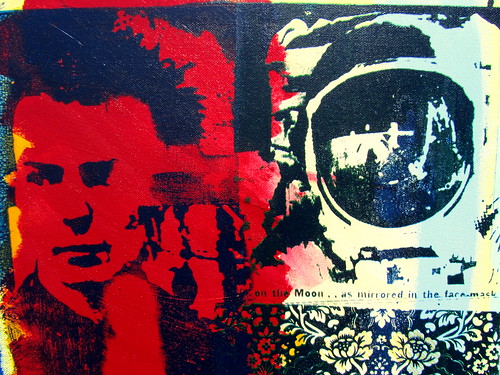
As an 11 year old I watched the first moon landing in 1969. I was mad about everything to do with space travel, I would read anything that was about rockets, cosmonauts and astronauts. Later in my life I shook the hand of a man who shook the hand of my all time hero Yuri Alekseyevich Gagarin, that was for me like touching history, if only secondhand (excuse the pun).
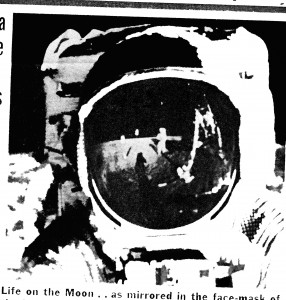
I have just been rummaging through old boxes of stuff and found the picture above – yellowed and faded – it still makes my heart flutter. I wish I’d been to the moon.

Woodcuts

The most inspirational woodcuts (for me) are by Émile Bernard. Émile Henri Bernard (April 28, 1868 – April 16, 1941) is known as a Post-Impressionist painter who had artistic friendships with Van Gogh, Gauguin, Eugene Boch and Cézanne. Most of his notable work was accomplished at a young age, in the years 1886 through 1897. He is also associated with Cloisonnism and Synthetism, two late 19th century art movements. Less known is Bernard’s literary work, comprising plays, poetry, and art criticism as well as art historical statements that contain first hand information on the crucial period of modern art to which Bernard had contributed. Bernard was in many ways, the young, educated and intellectual mentor, who was crucial in intellectualising and inspiring Paul Gauguin during the Pont Aven period of his career. Read more…


‘Bernard’s ideas fired Gauguin’s enthusiasm, and Bernard’s important painting Breton Women in the Meadow (1888; France, priv. col.), a starkly drawn and crudely painted composition depicting a Breton Pardon, enabled Gauguin to go on to produce his own revolutionary painting Vision after the Sermon: Jacob Wrestling with the Angel (1888; Edinburgh, N.G.) in a similar style and composition. Bernard exhibited Cloisonnist paintings and prints of Breton inspiration alongside Gauguin and other artists at the Exposition Universelle of 1889, at the Café Volpini. This exhibition acted as a catalyst on the Nabi group and drew a number of new adherents to the Pont-Aven school.’

Text from MoMA.org (original source Oxford University Press)


An object or thing never has the same functionality as its name or image.... I think Magritte said something like this 80 or so years ago.

A bit of an odd statement but if you think about it it is very true. An inert object (or landscape) can't tell you what it is, we rely on our experiences through out our lives to explain what we see. If we see a chequered hillside we know that the boundaries (if they are green) are most likely to be hedges and the whiteish blobs are probably sheep contained within the fields. We can estimate the feel of the landscape: warm, cold, steep, flat etc.

In many respects transferring theses visual clues into (in my case) paint gives a prompt, a reminder of the general feel of the landscape... an estimate.

In all cases the created image lies about its representation. A representation/illusion takes on more realness than the actual physical object, the object then becomes a metaphor for the created illusion. This in turn creates an additional reference for the object, an extra visual adjective eg. 'The sky was very Turneresque.' Turner's illusion becomes a metaphor for the real thing, which vividly describes [in words] the actual sky. The concrete object cannot say everything about itself - it has a limited vocabulary and is unable to say what is required of it, it is on many levels mute.
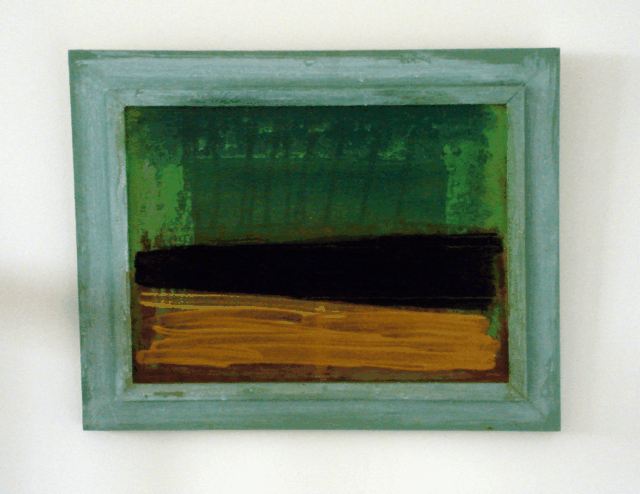
The constant questioning and declassification of what art is and what the content is has lead to this so called crisis in painting (there as always been a crisis in painting) - Painting is dead - the exponents of Conceptual Art tried to destroy the art object but failed - thought and the idea is the object. The primary aims of Conceptual Art in the 1960's was to carry out a theoretical examination of 'art' and through understanding propose 'concepts as art'. Two and three-dimensional art was in the doldrums, the essence of creating was the new Holy Grail. This was considered to be a bold step, proposing an idea as a work of art left the Artist with very little to exhibit or sell, the written word was usually all that was physically evident....it has taken me nearly 35 years to realize that what I do isn't pointless and that my unwavering trust in the conceptual philosophies (of artists and writers from Duchamp to Art and Language) has been misplaced. I'm enjoying my painting - for the first time. The 'world of art' and the 'world of everyday life' had already been discussed in Dada. "Life and art are one," proclaimed Tzara. Ultimately Dada reduced itself to vandalism, drawing moustaches on the Mona Lisa, instead of destroying the Louvre and genuinly starting again, something a real revolutionary movement would consider as its first option. It increased the status of the most banal object or event into something that ultimately provoked nervous laughter, a childish prank that has been taken seriously ever since. Conceptual Art attempted to be more serious in its approach. Unfortunately the original aims became diffused and the quality of thought became diluted and suffered a similar fate to Dada.

It is possible to tell more about a landscape or object in a painting than to actually experience the real thing - the editing and generalization required in painting enables the experience of the landscape to be viewed in shorthand. The greatest trick is to imply this with the minimum of effort. Unfortunately the majority of landscape art fails miserably however, 'Lake Lucerne: the Bay of Uri from above Brunnen' circa 1844 (below) is the ultimate painting of landscape and nature - it tells a massive story with very little content. This has been an important painting for me since the early 1970's. I have always admired the New York Abstract Expressionists of the mid 20th century but when I first saw this painting by Turner...... my socks were blown off. It is without doubt a clever (maybe unfinished) conceptual painting.

Turner

The scumbled and brilliant paint surface is, at first, difficult to decipher. A small house beneath a cliff is discernible in the lower left corner, while mountains loom on the right hand side of the canvas. As a work begun a year or two after Turner's 1842 visit to Switzerland and has been connected to a watercolor of the same subject completed that year.


(From the display caption September 2004 Tate Gallery, London)


Road trips, journeys, and speed inspire. The image below was taken on a road trip I did in 2007, with stays in Brussels, Zurich (it was going to be Prague – but the German authorities banned us from their country on the outward journey) Zagreb, Munich, Ipers. Going through France, Belgium, Luxemburg, Switzerland, Austria, Slovenia, Croatia and Germany. We did this in six days. Click on the image for more photographs of our 'Cannonball' journey.


I wish I’d painted this (maybe?)

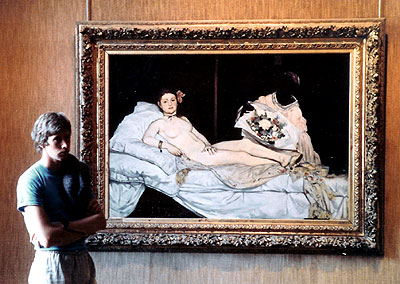
Manet’s Olympia (which is in the Musée d’Orsay) is probably one of my favourite paintings. In 1974 at Stourbridge College of Art I did a series of paintings based on ‘Page 3 models’ and I was intrigued how Manet’s Olympia had the same soft porn feel to it – inviting but not hardcore. I went to Paris in 1978 and took this photo which I’ve just rediscovered. I’ve no idea who the bloke is – he could be her pimp or maybe he was first in the queue.

Olympia

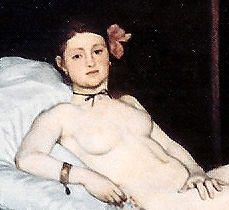
What shocked contemporary French audiences of the late 19th century was not Olympia’s nudity, nor even the presence of her black maid (the black female was regarded by 19th century Europeans as a savage, a nymphomaniac – to have a white woman naked with her maid clothed was a provocative statement). Olympia’s confrontational, erotic gaze and the symbolic references to her as a courtesan (demi-mondaine): the orchid in her hair, her bracelet, pearl earrings and the oriental shawl on which she lies, which are symbols of wealth and sensuality. The black ribbon around her neck, and her single cast-off slipper mark her as a temptress.

The painting was inspired by Titian’s Venus of Urbino, which in turn refers to Giorgione’s Sleeping Venus. Olympia’s authoritative hand (the model was Victorine Meurent) covers her nudity (same as a Page 3 girl) as if to emphasize her independence, sexual dominance and her status as an object of desire. Manet replaced the little dog (symbol of fidelity) in Titian’s painting with a black cat, which symbolized prostitution. People have suggested that she is looking in the direction of a door, as a client barges in unannounced, I would prefer to think she is waiting for me.

The  look

L I N K S

Thursday, 3 March 2011

Methodology

Methodology doesn't describe specific methods; nevertheless it does specify several processes that need to be followed. These processes constitute a generic framework. They may be broken down in sub-processes, they may be combined, or their sequence may change. However any task exercise must carry out these processes in one form or another.
Katsicas, Sokratis K. (2009) "35" Computer and Information Security Handbook Morgan Kaufmann Pubblications Elsevier Inc p. 605 


Rediscovering the printing process after nearly 40 years has been an interesting process - disappointingly modern inks are not as rich in colour (earthy colours are very plastic like) and modern waterbased inks don't become part of the surface, they sit on it, which is incredibly frustrating - the reason I took up printing in the first place was because of the absorbed flatness of the pigments.
The image below is a lithograph I did in 1978.


The most inspirational woodcuts (for me) are by Émile Bernard. Émile Henri Bernard (April 28, 1868 – April 16, 1941) is known as a Post-Impressionist painter who had artistic friendships with Van Gogh, Gauguin, Eugene Boch and Cézanne. Most of his notable work was accomplished at a young age, in the years 1886 through 1897. He is also associated with Cloisonnism and Synthetism, two late 19th century art movements. Less known is Bernard’s literary work, comprising plays, poetry, and art criticism as well as art historical statements that contain first hand information on the crucial period of modern art to which Bernard had contributed. Bernard was in many ways, the young, educated and intellectual mentor, who was crucial in intellectualising and inspiring Paul Gauguin during the Pont Aven period of his career. Read more…


‘Bernard’s ideas fired Gauguin’s enthusiasm, and Bernard’s important painting Breton Women in the Meadow (1888; France, priv. col.), a starkly drawn and crudely painted composition depicting a Breton Pardon, enabled Gauguin to go on to produce his own revolutionary painting Vision after the Sermon: Jacob Wrestling with the Angel (1888; Edinburgh, N.G.) in a similar style and composition. Bernard exhibited Cloisonnist paintings and prints of Breton inspiration alongside Gauguin and other artists at the Exposition Universelle of 1889, at the Café Volpini. This exhibition acted as a catalyst on the Nabi group and drew a number of new adherents to the Pont-Aven school.’

Text from MoMA.org (original source Oxford University Press)


An object or thing never has the same functionality as its name or image.... I think Magritte said something like this 80 or so years ago.

A bit of an odd statement but if you think about it it is very true. An inert object (or landscape) can't tell you what it is, we rely on our experiences through out our lives to explain what we see. If we see a chequered hillside we know that the boundaries (if they are green) are most likely to be hedges and the whiteish blobs are probably sheep contained within the fields. We can estimate the feel of the landscape: warm, cold, steep, flat etc.

In many respects transferring theses visual clues into (in my case) paint gives a prompt, a reminder of the general feel of the landscape... an estimate.


In all cases the created image lies about its representation. A representation/illusion takes on more realness than the actual physical object, the object then becomes a metaphor for the created illusion. This in turn creates an additional reference for the object, an extra visual adjective eg. 'The sky was very Turneresque.' Turner's illusion becomes a metaphor for the real thing, which vividly describes [in words] the actual sky. The concrete object cannot say everything about itself - it has a limited vocabulary and is unable to say what is required of it, it is on many levels mute.

The constant questioning and declassification of what art is and what the content is has lead to this so called crisis in painting (there as always been a crisis in painting) - Painting is dead - the exponents of Conceptual Art tried to destroy the art object but failed - thought and the idea is the object. The primary aims of Conceptual Art in the 1960's was to carry out a theoretical examination of 'art' and through understanding propose 'concepts as art'. Two and three-dimensional art was in the doldrums, the essence of creating was the new Holy Grail. This was considered to be a bold step, proposing an idea as a work of art left the Artist with very little to exhibit or sell, the written word was usually all that was physically evident....it has taken me nearly 35 years to realize that what I do isn't pointless and that my unwavering trust in the conceptual philosophies (of artists and writers from Duchamp to Art and Language) has been misplaced. I'm enjoying my painting - for the first time. The 'world of art' and the 'world of everyday life' had already been discussed in Dada. "Life and art are one," proclaimed Tzara. Ultimately Dada reduced itself to vandalism, drawing moustaches on the Mona Lisa, instead of destroying the Louvre and genuinly starting again, something a real revolutionary movement would consider as its first option. It increased the status of the most banal object or event into something that ultimately provoked nervous laughter, a childish prank that has been taken seriously ever since. Conceptual Art attempted to be more serious in its approach. Unfortunately the original aims became diffused and the quality of thought became diluted and suffered a similar fate to Dada.

It is possible to tell more about a landscape or object in a painting than to actually experience the real thing - the editing and generalization required in painting enables the experience of the landscape to be viewed in shorthand. The greatest trick is to imply this with the minimum of effort. Unfortunately the majority of landscape art fails miserably however, 'Lake Lucerne: the Bay of Uri from above Brunnen' circa 1844  is the ultimate painting of landscape and nature - it tells a massive story with very little content. This has been an important painting for me since the early 1970's. I have always admired the New York Abstract Expressionists of the mid 20th century but when I first saw this painting by Turner...... my socks were blown off. It is without doubt a clever (maybe unfinished) conceptual painting.


I wish I’d painted this (maybe?)

Manet’s Olympia (which is in the Musée d’Orsay) is probably one of my favourite paintings. In 1974 at Stourbridge College of Art I did a series of paintings based on ‘Page 3 models’ and I was intrigued how Manet’s Olympia had the same soft porn feel to it – inviting but not hardcore. I went to Paris in 1978 and took this photo which I’ve just rediscovered. I’ve no idea who the bloke is – he could be her pimp or maybe he was first in the queue.


What shocked contemporary French audiences of the late 19th century was not Olympia’s nudity, nor even the presence of her black maid (the black female was regarded by 19th century Europeans as a savage, a nymphomaniac – to have a white woman naked with her maid clothed was a provocative statement). Olympia’s confrontational, erotic gaze and the symbolic references to her as a courtesan (demi-mondaine): the orchid in her hair, her bracelet, pearl earrings and the oriental shawl on which she lies, which are symbols of wealth and sensuality. The black ribbon around her neck, and her single cast-off slipper mark her as a temptress.

The painting was inspired by Titian’s Venus of Urbino, which in turn refers to Giorgione’s Sleeping Venus. Olympia’s authoritative hand (the model was Victorine Meurent) covers her nudity (same as a Page 3 girl) as if to emphasize her independence, sexual dominance and her status as an object of desire. Manet replaced the little dog (symbol of fidelity) in Titian’s painting with a black cat, which symbolized prostitution. People have suggested that she is looking in the direction of a door, as a client barges in unannounced, I would prefer to think she is waiting for me.


L I N K S

Monday, 21 February 2011

Ubuntu

We are using Ubuntu (10.10).  This version is easy to install and is quick to load when installed. We have had a few problems getting a few of the software packages to work properly (or at all) but the basic 'Office' and 'Internet' bundle works brilliantly - this operating system and it's free software is a must if you are running a business on a shoestring. Get the free download.

Ubuntu is free of charge and has no licensing fees. You can download, use and share Ubuntu with your friends, family, school or business for absolutely nothing.

Latest news (RSS feed) - Behind the jargon there is a brilliant package.

Small Business – Ubuntu (10.10)

We are using Ubuntu (10.10).  This version is easy to install and is quick to load when installed. We have had a few problems getting a few of the software packages to work properly (or at all) but the basic … Continue reading
Posted in Linux!, Ubuntu, business, free | Leave a comment

Linux we like it!

We have always been fascinated by Linux based computers – at the moment we are using Ubuntu (7.10). Get the free download or request a free CD.Ubuntu is a community developed, linux-based operating system that is free and perfect for … Continue reading
Posted in Linux!, Quanta Plus, Ubuntu | Comments Off

Ubuntu

M4tr  has always been fascinated by Linux based computers -  at the moment we are using Ubuntu (7.10). Get the free download or request a free CD here: https://shipit.kubuntu.org/ Ubuntu is a community developed, linux-based operating system that is free … Continue reading
Posted in Linux! | 1 Comment

Bollocks

Robert Rauschenberg was a massive influence on my painting, printing and music. Images (and sounds) that are arbitrarily spliced together in an apparent random manner will, when juxtaposed against each other, create a narrative. This meshing together of unrelated imagery may appear to be arbitrary but the intellectual decision making that goes with the process is absolutely phenomenal. It is therefore unrealistic to expect the uneducated masses to view these images as ‘real art’. The birth of Photoshop has enabled everybody to create ‘non-intellectual’ versions of Rauchenberg (and Warhol) – only the educated truly understand.

Taken from blurb of the show at Broomhill (June 2010)

Bollocks

Robert Rauschenberg was a massive influence on my painting, printing and music. Images (and sounds) that are arbitrarily spliced together in an apparent random manner will, when juxtaposed against each other, create a narrative. This meshing together of unrelated imagery may appear to be arbitrary but the intellectual decision making that goes with the process is absolutely phenomenal. It is therefore unrealistic to expect the uneducated masses to view these images as ‘real art’. The birth of Photoshop has enabled everybody to create ‘non-intellectual’ versions of Rauchenberg (and Warhol) – only the educated truly understand.

Taken from blurb of the show at Broomhill (June 2010)

Music then back to work!!!!

Sometimes you just have to zone out and listen to music when you get 'code blind'.
Julie Peel – Music to SEO to
Posted on by admin
Here we are again, sat in front of my trusty old Mac, fiddling with code for my clients who want to get their website onto page one of Google. Keywords and search terms – this solitary career in SEO is … Continue reading ?
Posted in mp3, music, seo

Optimization by music
Posted on by admin
It is a sunny Sunday morning and the ocean looks inviting but unfortunately work is piling up. Here is some more music to Seo to and maybe inspire some key search words from – Natasha Kahn: Primary School teacher meets … Continue reading ?
Posted in music, optimization, seo

Amazon MP3
Posted on by admin
Have you tried buying mp3s from Amazon? Amazon MP3 offers millions of songs and albums from your various artists in most genres. The downloads are all in MP3 format, which means they can play on any digital media player. Songs … Continue reading ?
Posted in mp3, music


Friday, 18 February 2011

Woodcuts

Rediscovering the printing process after nearly 40 years has been an interesting process – disappointingly modern inks are not as rich in colour (earthy colours are very plastic like) and modern waterbased inks don’t become part of the surface, they sit on it, which is incredibly frustrating – the reason I took up printing in the first place was because of the absorbed flatness of the pigments.

Thursday, 17 February 2011

White Borders

  • Fingerprints on white borders – nightmare on a short print run. A fingerprint is an impression left by the friction ridges of a human finger = fingerprints are the traces of an impression from the friction ridges of any part of a human hand. Impressions of fingerprints may be left behind on a surface by the natural secretions of sweat from the eccrine glands that are present in friction ridge skin, or they may be made by ink or other substances transferred from the peaks of friction ridges on the skin to a relatively smooth surface such as a fingerprint card. Fingerprints records normally contain impressions from the pad on the last joint of fingers and thumbs, although fingerprint cards also typically record portions of lower joint areas of the fingers.
  • Action Painting – Pollock. Print dribbled paint.
Read more...

Alms at Myspace Music


Find more artists like Alms at Myspace Music
How good is this track!!!! – Listen to more tracks by Alms at Myspace Music

Alms early mix DEMOS NOW UP – gigs a’plently a’coming in run up to launch of the mastered first EP

Sunday, 13 February 2011

Is Business Art


The cliché 'we can learn from history' is in many cases nonsense - we continue to make the same mistakes over and over again. We do however have to ride that fast learning curve to create new product and have new ideas. Business is not a static immovable object it has to evolve. We have to morph into different markets, pushing our ideas onto the next phase - this is what artists do. Boundaries have to be broken and new frontiers challenged or we simply have to do it better than our rivals.

There were many artists trying to claim freedom from nature, to allow themselves the pleasures of more self expression but they were held back by the simple fact that man himself was tied down with his links to nature. We have now become at home with the Internet and its optimized retail opportunities. The steps the artists of the 1880’s were looking for was a break from observed representation. Symbolism and its search for new boundaries of creativity within literature and poetry began to point the way for these young men, their almost post modernist approach to their art looked to steal ideas from every form of intellectual discipline. Web designers and SEO gurus are doing the same now; they are copying code, search words, keywords and optimization tricks from each other. These painters, over a hundred years ago, were a clique and were accused by their contemporaries of being too intellectual to be serious painters. Search Engine Optimization is also a mysterious clique with its differing ethics. Now is the time to break through this structured discipline and re-invent Search Engine Optimization and get our businesses moving forward.

Search sitemaps-xml.com for more articles:

sitemaps-xml.com has been in the Technorati Top 100 Small Business blogs during 2010 and 2011.